Article
Integrity as an Innovation Strategy: Why Moral Clarity Drives Creativity, Not Just Compliance
(Part 1 of The Best Leaders Playbook — Building Trust Systems Series)

The Word Everyone Nods At (and Then Ignores)
Integrity. It’s one of those words that sounds good in a mission statement and dies in the hallways.
Ask any executive team what their core values are, and you’ll hear it listed right after “excellence” and “teamwork.” Then watch how quickly it disappears when money, speed, or politics enter the room.
We treat integrity like a moral ornament — nice to have, but optional when things get complicated.
But here’s the truth: integrity isn’t just ethical. It’s efficient.
It’s not a virtue. It’s a system.
The Hidden Link Between Integrity and Innovation
Most companies think integrity is about compliance — following rules, avoiding lawsuits.
But at its core, integrity is about safety. Not physical safety — psychological safety.
And that’s what innovation feeds on.
When people trust that honesty won’t get them punished, they start sharing real ideas. They tell the truth about what’s broken. They experiment without fear of being labeled “the problem.”
That’s when creativity starts compounding.
Integrity isn’t just “doing the right thing.” It’s creating conditions where truth can breathe.
A Story from a Hospital, Not a Startup
Years ago, I visited a hospital that had drastically reduced medical errors. Not through technology — through culture.
They introduced something called “Learning Rounds.” Whenever a mistake happened, the rule was: no blame, no cover-up, full transparency. They asked one question — “What did we learn?”
Reporting errors skyrocketed. Within a year, preventable harm dropped by almost half.
They didn’t become less human. They became more honest.
That’s integrity operationalized.
And it worked because people finally trusted that truth was an asset, not a liability.
Why We Avoid It
Integrity sounds easy until it costs something. That’s when you learn what you actually believe.
It’s easy to be transparent when results are great. It’s harder when you miss numbers and the board’s breathing down your neck.
But that’s the moment that defines culture. Because your people are watching.
And they don’t listen to what you say. They watch what you tolerate.
The Real Test of Integrity
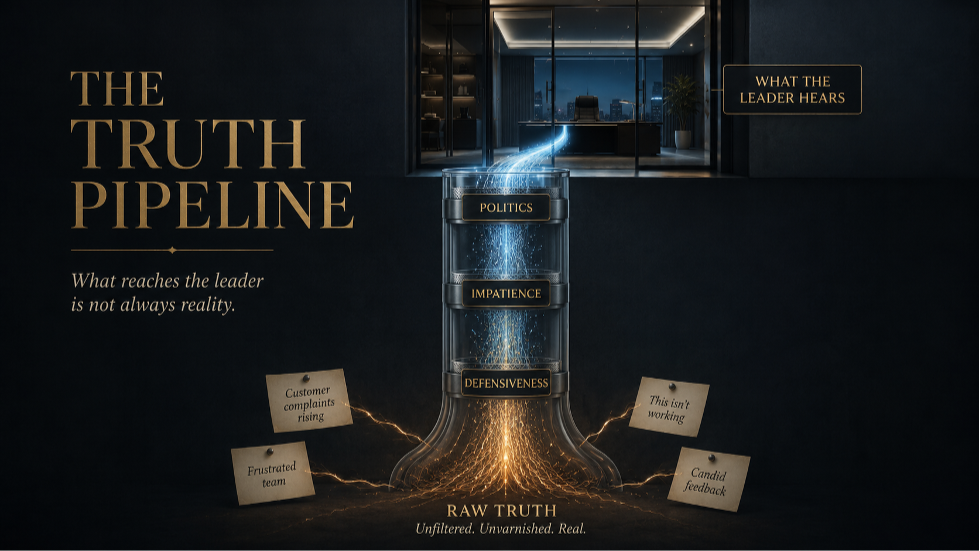
It’s not the big scandals that erode trust. It’s the small, quiet compromises that everyone sees but no one names.
When leaders say, “We value people,” and then cut the travel budget for front-line staff while approving their own offsite. When they say, “We’re transparent,” but make decisions in a closed room and announce them like royal decrees.
Culture doesn’t break all at once. It erodes drip by drip.
And once people stop believing leadership’s words, they stop giving leadership their truth.
That’s how innovation dies — not from lack of ideas, but from lack of honesty.
A CEO’s Wake-Up Call
A CEO I worked with once asked his team, “Why don’t we see more creativity around here?”
Someone finally said, “Because we don’t know which version of the truth you want.”
That was the turning point.
He realized that his team wasn’t scared of failure — they were scared of him.
So he started modeling what he wanted. He admitted mistakes publicly. He gave credit generously. He rewarded dissent.
Within six months, the company’s product pipeline exploded with new ideas.
Integrity didn’t slow innovation down. It unlocked it.
Why Integrity Makes Companies Faster
When people trust leadership, decision-making accelerates. You stop burning time managing optics and start managing reality.
You don’t need six layers of approval or fifteen PowerPoints to make a call because people know the intent is honest.
Integrity removes bureaucracy because it removes suspicion.
That’s what most companies miss: trust is the ultimate efficiency play.
Funny but True
I once asked an executive, “Would you say integrity is one of your company’s top values?”
He said, “Absolutely — as long as it doesn’t slow down the deal.”
We both laughed, but he wasn’t joking.
That’s how integrity quietly dies — not from corruption, but from convenience.
How to Operationalize Integrity
- Reward truth over polish. Praise the person who surfaces the hard issue, not just the one who packages it nicely.
- Separate mistakes from misconduct. Punish deception, not failure. Honest errors are how organizations learn.
- Make values the operating system, not wallpaper. Link performance reviews and promotions to how results are achieved, not just what’s achieved.
- Own your missteps publicly. Every time a leader says, “I got that wrong,” trust spikes across the company.
- Codify transparency. Make open communication a process, not a personality trait.
The Emotional ROI of Integrity
Integrity doesn’t just make people behave better. It makes them feel safer.
And when people feel safe, they think bigger. They collaborate faster. They tell the truth sooner.
Innovation isn’t born from pressure. It’s born from permission — permission to be real.
Your Challenge This Week
Ask your team one question:
“What truth are we avoiding right now?”
Then do the hardest part — listen without reacting.
You’ll probably hear something uncomfortable. Good. That’s where the next wave of innovation is hiding.
Final Word
Integrity isn’t moral theater. It’s the architecture of trust.
It’s what lets people experiment without fear and tell you the truth before the market does.
And the beautiful paradox is this: When you stop performing integrity and start practicing it, creativity stops needing permission.
Because honesty — quiet, consistent honesty — is the most radical form of innovation there is.
share this
Related Articles
Related Articles