Research
The research behind the methodology
The Hagberg methodology rests on two separate research programs: the founder study behind Founders, Keepers, and ongoing research on nearly 2,000 executives. They are reported separately because they are separate.
Nearly 50 years of practice (since 1979) · more than 15 years of founder research (since 2009) · two separate studies, reported separately
How the research works
The founder study
The founder study documented in Founders, Keepers covers 122 founders drawn from three recruitment sources. Each founder was assessed on the Personality and Leadership Profile and on 360 ratings across 46 competencies. Success was measured as MOIC. The highest-returning 10x group was compared against an equal-sized group with the lowest returns. Founder scores were read against a norm group of 1,500 executives from companies of varying sizes, industries and countries.
The executive research
The broader executive leadership research is documented in Dr. Hagberg's published essays rather than in the book. It covers nearly 2,000 executives across industries worldwide. Within that group, the top 200 leaders were identified as the best leaders by their 360 ratings. The analysis draws on over 60,000 pages of coworker comments across the full leader dataset.
The thesis
Leadership failure is rarely an intelligence problem. It is almost always a behavior problem the leader cannot see
Neither dataset is a survey. Both are built from years of integrated assessment, stakeholder feedback and outcome tracking. They cover founders who scaled, founders who stalled, and founders who were replaced. They also cover executives rated by the people who worked around them every day.
Read across both sets, one pattern is overwhelming: the difference between leaders who scale and leaders who do not is not vision, intelligence, market timing or work ethic. It is the willingness (and the ability) to change specific, observable behaviors as the company evolves past the leader's first operating style.
That is what this research measures, and that is what the engagements built on top of it are designed to change.
The dataset
Two research programs. Two separate datasets
The founder study is the research documented in Founders, Keepers. The executive leadership research is separate, and is documented in Dr. Hagberg's published essays.
Study one · The founder study · Source: Founders, Keepers
Founders assessed
Drawn from three recruitment sources, each assessed on the Personality and Leadership Profile and on 360 ratings.
Competencies rated
Leadership, management, social-skill, decision-making and behavioral competencies. The full list is published in the book's appendix.
Executive norm group
A global comparison sample across company sizes, industries and countries, used to build the normal distribution founders were scored against.
MOIC outcomes
The 10x-return group compared against an equal-sized group with the lowest returns. Outcome data supplied by Arbor Ventures, an independent third party.
Significant competencies
Of the 46 tracked, 15 were statistically significant between cohorts via stepwise discriminant analysis with validation modeling, resolving into four clusters.
Pages of founder 360 comments
Written feedback on the founders themselves, analyzed alongside the quantitative ratings.
Years of data collection
The 360 database has been built continuously since 2009.
Recruitment sources
The 122 founders were recruited through three separate channels rather than a single pipeline.
Study two · The executive leadership research · Source: published essays
Executives worldwide
Assessed on personality and on 360 ratings of behavior, across industries and geographies.
Best leaders identified
The highest-rated group in the dataset, identified by their 360 feedback ratings and then analyzed in depth.
Pages of comments
Coworker commentary across the full leader dataset, analyzed alongside the quantitative ratings, not instead of them.
Years of practice
Dr. Hagberg came to Silicon Valley from academia in 1979, nearly 50 years of practice behind the instruments and the interpretation.
What the research found
Each finding below carries the sample it came from and its source: the book or a published essay. Where an essay unpacks the finding at length, it is linked beneath.
From the founder study
122 founders · 46 competencies · Source: Founders, Keepers
Of the 46 competencies, 15 separated the successful founders from the unsuccessful ones.
Stepwise discriminant analysis with validation modeling identified 15 statistically significant competencies between the highest-returning founders and the lowest-returning group. Those 15 resolve into four clusters.
122 founders · Source: Founders, Keepers
The outcome data came from an independent third party.
MOIC figures were supplied by Arbor Ventures, not self-reported by the founders. Success in this study is measured by someone else's books, a materially stronger basis than reputation or self-assessment.
Norm group of 1,500 executives · Source: Founders, Keepers
The founders were measured against a real global baseline.
Scores were compared against a norm group of 1,500 executives drawn from companies of varying sizes, industries and countries, which is what establishes the normal distribution founders were scored against.
Since 2009 · Source: Founders, Keepers
The 360 database has been built continuously since 2009.
The founder research rests on more than 15 years of ongoing data collection rather than a single point-in-time survey, including nearly 5,000 pages of 360 feedback comments on the founders themselves.
122 founders · Source: Published essay
Personality traits correlate directly with financial outcomes.
Comparing founders who returned at least 10x MOIC with those in the lowest-returning group revealed a direct correlation between founders' personality traits and the financial results of their companies.
Rethinking Founder Mode: What Really Drives Startup Success →122 founders · Source: Published essay
The highest 360 ratings clustered in three behaviors.
The most successful founders scored highest on 360 ratings for Creating Buy-In, Delegation & Empowerment, and Adaptability.
The Magic of Buy-In: How Top Leaders Get Everyone on Board →122 founders · Source: Published essay
Most founders cannot delegate.
58% of founders were rated poor at delegating in their 360 feedback; only 41% were good delegators. Poor delegators had higher employee turnover.
Breaking Free from Founder Mode: The Power of Delegation →122 founders · Source: Published essay
Adaptability is not optional at the top end.
Founders in general are adaptable, but the most financially successful ones took adaptability further, listening to feedback and facts rather than defending a position.
Adaptability: The Founder's Lifeline →122 founders · Source: Published essay
The genius jerk stereotype is not supported by the data.
The founders with the strongest financial outcomes were not the ruthless, domineering archetype. They showed emotional control and social insight.
The Toxic Allure of the Genius Jerk →
From the executive leadership research
~2,000 executives · Source: Published essay
Inspiration is the number one correlate of leadership effectiveness.
Across the executive dataset, being an inspirational leader was the single strongest correlate of measured leadership effectiveness.
Inspire or Undermine: The Leadership Choice That Defines Success →Top 200 of ~2,000 · Source: Published essay
The best leaders hold a confidence paradox.
The top 200 leaders were consistently described as humble, authentic, empathetic and open-minded while simultaneously scoring as assertive, self-assured and insistent.
The Confidence Myth →60,000+ pages of comments · Source: Published essay
Trust was a hallmark of the best leaders.
Coworker comments describing the highest-rated leaders returned repeatedly to the same qualities: dependable, reliable and fair.
The Trust Advantage: Build It or Break It →60,000+ pages of comments · Source: Published essay
The patterns are visible in the written record, not only the scores.
Over 60,000 pages of coworker comments across 46 leadership competencies were analyzed alongside the quantitative ratings.
The Ultimate Guide to Leadership Mastery →
The founder study · four clusters
What separated the founders who returned 10x
The 15 statistically significant competencies resolve into four clusters. These are the book's own four statements.
Successful founders are adaptable
They take in feedback and facts and change course, rather than defending a position because it is theirs.
Successful founders work through others
They delegate real authority and build commitment, instead of routing the company's decisions back through themselves.
Successful founders understand the importance of scaling
They accept that the operating style that started the company is not the one that grows it, and they build the structure that scale requires.
Successful founders have strong personal grounding
They hold steady under pressure, with a sense of self that does not depend on the company's last data point.
And running through all four
Self-awareness does not sit in one cluster. In Dr. Hagberg's framing it is the "phantom planet", unseen, but exerting its gravity across the entire constellation of competencies.
Why Successful Founders Win — and Others Crash and Burn →Key patterns
Five patterns that show up again and again
Each one is visible in the data, diagnosable in an individual leader, and coachable into measurable behavior change.
Founder traits and CEO traits are different jobs in the same body
The drive, conviction and intensity that get a company started are not the behaviors that scale it. Many founders treat scaling as a strategy problem when it is actually a behavioral one.
Strengths derail before weaknesses do
Founders rarely stall because of what they cannot do. They stall because of what they keep doing, past the point where it is still useful. Vision becomes distraction, speed becomes chaos, confidence becomes defensiveness.
Self-perception drifts as the company grows
The bigger the company gets, the wider the gap tends to be between how a founder believes they are showing up and how their team experiences them. Comparing Predicted 360 forecasts from the Personality and Leadership Profile with actual coworker ratings helps sharpen the behavioral read.
The third pillar is almost always the missing one
Most founders are wired as Visionary Evangelists, and many are strong Relationship Builders. The Manager-of-Execution pillar (priorities, delegation, accountability, operating rhythm) is where most founder-led companies break.
Founders who scale do one thing differently: they change their own behavior
Not their personality, not their values, not their vision. Specific, observable, measurable behaviors, and they let the data, rather than their self-image, tell them which ones.
Founder operating patterns
Four operating defaults we see in practice
These four are working shorthand from coaching practice rather than a finding of either study. They are not personality types. Each is an operating default with a strength that built the company and a risk that limits it at scale.
The Evangelist
Vision-led, magnetic, brilliant at attracting belief, talent and capital. Scaling risk: uses vision as a substitute for delegation, accountability and execution discipline.
The Operator
Detail-fluent, high-control, ships product, runs the numbers. Scaling risk: stays in the work the company needed them in two stages ago, so senior hires underperform because they were never actually given the role.
The Builder of People
Strong relationship builder, high trust, loyal team. Scaling risk: avoids hard performance calls, lets the bar drift, and confuses harmony with alignment.
The Independent
Self-reliant, fast, decisive, allergic to dependence. Scaling risk: isolates, stops seeking counsel, and loses the early-warning system that comes from a real executive team.
What we measure
Four instruments generate the data behind the research and behind every engagement.
Personality and Leadership Profile
A 340-item assessment that measures 46 personality traits and, using machine learning, predicts 46 leadership, management, social-skill, decision-making and behavioral competencies.
A leader receives a structured read of the traits that drive how they lead under pressure, interpreted in a debrief rather than handed over as a score sheet.
Used in the founder study documented in Founders, Keepers.
360-degree feedback
Structured ratings and written comments from the people who work around a leader, covering the same 46 leadership, management, social-skill, decision-making and behavioral competencies.
A leader receives a picture of how their behavior actually lands with bosses, peers and direct reports, including the verbatim record.
Used in both research programs. The full competency list is published in the appendix of Founders, Keepers.
Predicted 360
Included with the Personality and Leadership Profile: models trained on real Personality and Leadership Profile and 360 data forecast how coworkers are likely to rate the leader across 46 competencies.
A forecast before raters are surveyed, with the gap between predicted and actual ratings sharpening the development work when a Hagberg 360 follows.
A current Hagberg Consulting instrument. Not part of the research documented in the book.
Influence Report
Included with the Personality and Leadership Profile: links the leader's specific personality traits to the leadership competencies they drive.
A read on which personality traits help the leader's impact and which get in the way, translated into concrete behaviors to work on.
A current Hagberg Consulting instrument. Not part of the research documented in the book.
A note on the instruments
All four instruments are proprietary to Hagberg Consulting Group. The 46-competency framework is named openly here and printed in full in the appendix of Founders, Keepers. The item wording, scoring, machine-learning model, norms, percentile bands and interpretation methodology are not published. The instruments are available through engagements, or to qualified practitioners through licensing.
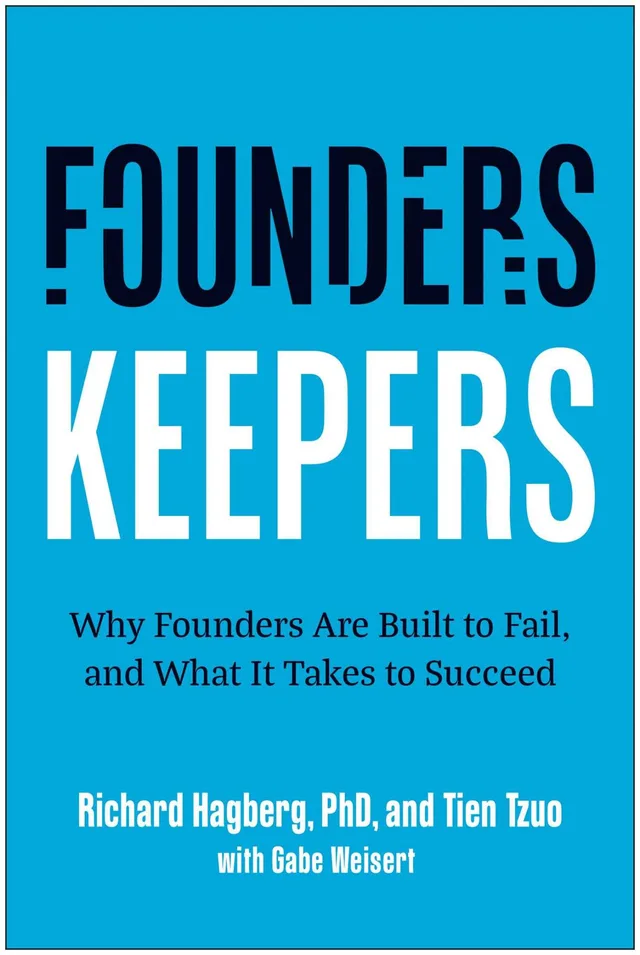
Where the founder study is published
The founder study, in book form
Founders, Keepers documents the founder study: the 122 founders, the MOIC comparison, the 46 competencies (printed in full in the appendix) and the four clusters that separated the top group. It carries a foreword by Peter Fenton, general partner at Benchmark.
The broader executive leadership research is not in the book; those findings are published in the essay library on this site.
Where the research goes to work
From data to engagement
Founder leadership
The advisory and coaching practice built directly on top of the research: diagnose the pattern, evolve the operating system.
Learn more →Assessments and data
The Personality and Leadership Profile, 360, Predicted 360 and Influence Report instruments that produce the data this research is built from.
Learn more →Investor and board advisory
Founder scalability, succession and leadership-risk reads for investors and boards making a call on the person, not just the plan.
Learn more →Common questions
How large is the dataset?
There are two separate programs. The founder study is documented in Founders, Keepers. It covers 122 founders from three recruitment sources. Each was assessed on the Personality and Leadership Profile and on 360 ratings across 46 competencies. It includes nearly 5,000 pages of 360 feedback comments. Founder scores were read against a norm group of 1,500 executives from companies of varying sizes, industries and countries. The separate executive leadership research, documented in Dr. Hagberg's published essays, covers nearly 2,000 executives worldwide, from which the top 200 leaders were identified as the best leaders by their 360 ratings, drawn from over 60,000 pages of coworker comments across the full leader dataset.
How were successful founders defined?
Financially, and by an independent third party. Outcomes were captured as MOIC (Multiple on Invested Capital), supplied by Arbor Ventures rather than self-reported. The group returning 10x was compared against an equal-sized group with the lowest returns, and the behavioral and personality data was compared between those two groups.
How were the differentiating competencies identified?
Of the 46 competencies tracked, 15 were statistically significant between the successful and unsuccessful founder cohorts, identified through stepwise discriminant analysis with validation modeling. Those 15 competencies resolve into four clusters.
How long has the data been collected?
Dr. Hagberg has been building the 360 database since 2009, so the founder research represents more than 15 years of data collection. That sits inside a practice he began when he came to Silicon Valley from academia in 1979, nearly 50 years.
Is the research published?
The founder study is published in Founders, Keepers, which also prints the full list of 46 competencies in its appendix. The broader executive leadership findings are published in the essay library on this site. The instrument items, scoring, machine-learning model, norms and interpretation methodology are proprietary to Hagberg Consulting Group and are not published.
Can I take these assessments?
Yes, through an engagement. Four instruments do the measuring: the Personality and Leadership Profile, the 360-degree feedback system, the Predicted 360, and the Influence Report. All four are administered as part of coaching and assessment work with founders, executives and executive teams. They are not available as a self-serve download, because the value is in the interpretation.
Can other coaches license this?
Yes. The instruments are proprietary to Hagberg Consulting Group and are available to qualified practitioners through licensing, which includes training in how the instruments are interpreted. Start with a conversation.
“Rich has not just the reasoning, which, of course, is the mark of a great coach, but he has the data set, so he knows what great looks like. This is extremely rare.”
Begin
Find out which pattern is yours, before the company does
Every engagement starts with a conversation about the pattern you are trying to understand, and what the data already suggests about where the leverage is.