Article
10 Traps Founders Should Avoid When Building Early Stage Startup Teams
July 25, 2024
Steer Clear of These Pitfalls to Build a Strong and Motivated Startup Team

While building a startup team, it's crucial to recognize and avoid common pitfalls that can hinder your success. Here are ten traps founders should steer clear of to ensure their team remains effective and motivated.
- One of the most significant traps is hiring for control rather than competence. It's tempting to bring on people who will only agree with you, but this can stifle innovation and critical thinking. Instead, seek out team members who challenge and expand your ideas. Don’t undervalue the importance of experience and domain knowledge; these qualities are essential for navigating the complexities of a startup.
- Micromanaging team members is another common pitfall. Constant oversight can demoralize employees and stifle creativity. Trust your team to handle their responsibilities without hovering over them. Micromanagement can create dependency, preventing team members from developing their problem-solving skills and taking initiative.
- Failing to define roles clearly can lead to confusion and conflict within the team. Without well-defined roles, team members might duplicate efforts or leave critical tasks undone. Clearly establishing who is responsible for what promotes efficiency and accountability.
- Neglecting team culture is a mistake that can lead to a toxic work environment. A strong, positive culture aligns team members with the company’s values and mission. Failing to address cultural issues can result in misalignment and decreased morale.
- Ignoring team input is a surefire way to miss valuable insights and innovative ideas. Engaged team members are more likely to contribute their best work. When their input is overlooked, it can lead to disengagement and reduced morale. Make it a priority to listen to and act on feedback from your team.
- Inadequate communication can create significant problems. Information gaps result in misunderstandings and mistakes, while team members may feel isolated and disconnected from the company’s vision and goals. Prioritize clear, transparent communication to keep everyone aligned and informed.
- Overemphasizing short-term goals at the expense of long-term planning can be detrimental. While immediate objectives are important, focusing solely on them can hinder sustainable growth and strategic planning. Additionally, an intense focus on short-term results can lead to team burnout and high turnover rates.
- Resisting change is another trap that can prevent a company from evolving and staying competitive. Being open to new ideas and adapting strategies as needed is essential for growth. Failing to embrace change can result in missed opportunities for innovation and improvement.
- Poor conflict management can damage team cohesion. Ignoring conflicts allows issues to escalate, while ineffective resolution can lead to lingering resentment. Developing strong conflict resolution skills is crucial for maintaining a healthy team dynamic.
- Finally, overconfidence in leadership can create blind spots. While self-confidence is important, too much can prevent you from seeing your own weaknesses and the potential for mistakes. A strong ego can make it difficult to accept and act on constructive criticism, hindering personal and team growth.
By avoiding these common traps, founders can foster a positive, productive team environment that supports sustainable growth and success. Implementing these strategies will help ensure that your startup team remains motivated, innovative, and aligned with the company’s vision.
share this
Related Articles
Related Articles
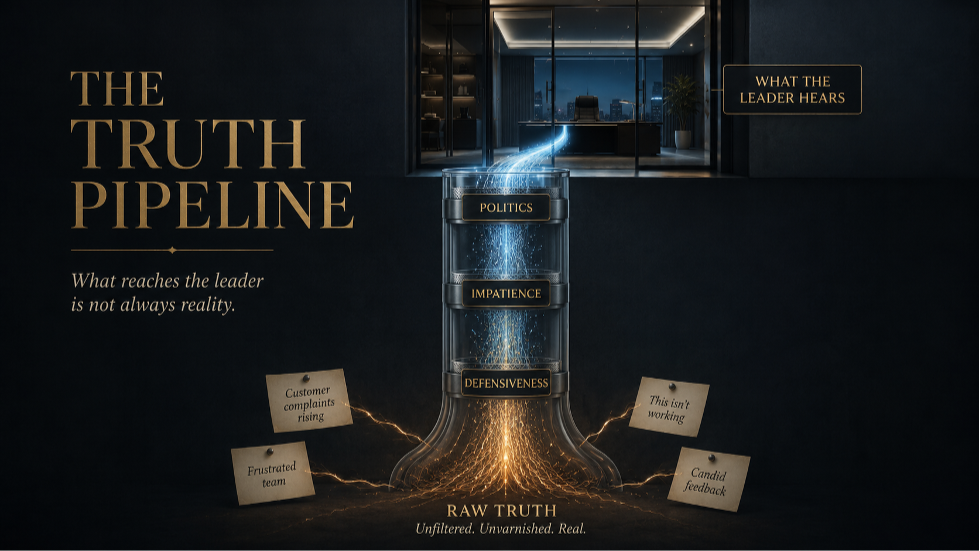
After many years of coaching leaders, I have learned something that should make every executive uncomfortable. People do not automatically tell leaders the truth. They tell leaders the version of the truth they think the leader can handle. If you are defensive, they edit. If you are impatient, they shorten. If you are dismissive, they soften. If you are punitive, they hide. If you are brilliant but emotionally clumsy, they may still respect you, but they will manage you. And once people start managing you, you are leading theater. The higher you go, the more people study you before they speak. They watch your face, listen to your tone, and adjust. They give you the headline without the emotional context. They bring you the problem after it has become unavoidable. They agree in the meeting and dissent in the hallway. That is how leaders lose contact with reality. Not all at once. Slowly. Politely. Professionally. With calendar invites. Connection Is Not About Being Liked Connection is not about becoming everyone's buddy. It is not about being endlessly available, emotionally gushy, conflict avoidant, or so supportive that no one knows whether you actually have standards. That is not leadership. That is codependence with a title. Connection is the ability to make another person feel seen, respected, and safe enough to tell you what is real. That is it. It does not require agreement, lowered standards, or meetings where everyone discusses feelings while the business quietly catches fire. People open up when they feel safe. People shut down when they feel judged, dismissed, humiliated, rushed, or corrected too quickly. Connection is not the opposite of performance. It is how you get access to the information that performance depends on. Every Organization Has a Truth Pipeline The question is whether reality moves through it cleanly or gets filtered on the way up. In a healthy culture, people tell the leader what they see early enough for it to matter. They raise concerns before the decision is locked. They disagree before the strategy fails. In an unhealthy culture, the truth gets laundered. Bad news becomes "some emerging concerns." Fear becomes "alignment issues." Resentment becomes "communication gaps." Lack of trust becomes "cross-functional friction." By the time the leader hears the truth, it has been professionally deodorized. Many leaders unknowingly create this problem. They say they want candor, but their behavior teaches caution. They interrupt, argue with feedback, explain too soon, punish bad news with irritation, and turn every concern into a debate. Then they wonder why people are not more transparent. Here is the simple answer: because transparency has not felt safe. Small Moments Decide Everything Connection is built in small moments, not grand declarations. At work, bids for connection sound ordinary: "Do you have a minute?" or "I may be wrong, but I see it differently." These are not just comments. They are tests. Every time someone reaches toward you, even slightly, your response teaches them what kind of relationship this is. You can turn toward, turn away, or turn against. Turning toward means you engage: "Tell me more," or "What are you seeing that I may be missing?" Turning away means you avoid the moment: "I'm busy," or "Let's not overthink this." Turning against means you respond with irritation, superiority, sarcasm, or contempt: "That makes no sense," or "We already covered this." Most leaders do not turn against people because they are trying to be cruel. They do it because they are busy, pressured, impatient, or convinced they already understand the issue. But the impact is the same. The person learns, "This is not safe." After enough experiences like that, people still communicate, attend meetings, and send updates. But the deeper truth goes underground. Listen for the Conversation Beneath the Conversation In every important conversation, there are usually two conversations happening. The first is the official conversation: the product launch, the missed deadline, the strategic decision. The second is the human conversation underneath it: Can I trust you? Is it safe to disagree? Do you actually want the truth? Disconnected leaders hear only the official conversation. Connected leaders listen for both. This does not mean they become therapists. It means they understand that people are not reasoning machines with job titles. They are status-sensitive, threat-sensitive, belonging-sensitive creatures trying to get work done while protecting themselves. If you ignore that layer, you misunderstand the meeting. The leader who misses the second conversation will often solve the wrong problem with great confidence. That is a specialty of very smart people. Make Contact Before You Make Your Point If you want people to tell you the truth, remember this rule: Make contact before you make your point. Before you explain, correct, defend, decide, or solve, show the person that you understand something about their experience. Not agree. Understand. You can say, "I can see why that would bother you," or "You are worried this decision will create confusion." Those statements do not require surrender. They require attention. Analytical leaders often resist this because they think understanding someone's emotion means endorsing their conclusion. It does not. You can understand someone and still disagree. You can validate the concern and still make a hard decision. But if you skip understanding, your eventual decision will feel imposed, even if it is correct. Connection first. Influence second. Reverse the order, and you may win the argument while losing access to the person. Stop Solving Too Soon Some leaders use problem-solving as a socially acceptable way to avoid contact. Someone says, "I'm overwhelmed." The leader says, "Let's reprioritize." That may be useful. But if you move there too quickly, the person may experience it as, "Please make your feelings operationally convenient." Solving too soon tells people, "Your emotional experience is a problem I want to make disappear." Listening first tells them, "Your experience matters to me." Before solving, ask one better question: "What are you worried I am not understanding?" Or the most important leadership question: "What am I missing?" That one shift creates space for truth. Contempt Kills Candor If there is one behavior that destroys connection fastest, it is contempt. Contempt says, "I am above you." It may be loud, but more often it is subtle: an eye roll, a sigh, a smirk, or a clipped tone. Contempt is especially dangerous in smart leaders because it can hide inside intelligence. The leader experiences himself as clear or efficient. The other person experiences being reduced. Once people feel contempt, they become careful, performative, and compliant instead of candid. If you want the truth, you have to become someone people can disagree with without feeling diminished. Repair Is How Trust Gets Rebuilt You will miss people. You will interrupt. You will get impatient. You will defend yourself. You will explain too soon. You will turn away when you should have turned toward. Welcome to the species. The goal is not perfection. The goal is repair. Repair is the moment when you notice a rupture and come back. "I came in too hard. Let me try that again." "I answered too quickly and missed what you were really saying." "I got defensive. Keep going." These sentences are not weakness. They are maintenance. People do not need you to be flawless. They need to know you can notice your impact and come back. The Real Payoff The payoff from connection is not that everyone likes you. This is leadership, not summer camp. The payoff is that people bring you more reality. They tell you what is happening sooner. They disagree before the mistake is baked in. They warn you when the culture is drifting. They admit confusion before execution fails. That is how connection improves results. It gives you better data. It lowers distortion. It deepens trust. It makes hard conversations possible. The deepest leadership question is not: "Did I make my point?" It is: "Did I earn the truth?" Because if people do not trust you with the truth, your intelligence will not save you. You will be making decisions from edited data and managing appearances. You will be leading the version of reality people think you can tolerate. And eventually, reality always wins. Connection is how leaders earn the truth. And the truth is what keeps leaders, companies, and relationships alive.

Founder who stops learning does not usually look stupid. They look confident. Busy. Decisive. Certain. And increasingly wrong. That is what makes the problem so dangerous. I coach founders, studying personality, and watching them either scale or stal. I have become convinced that learning agility is one of the most important predictors of whether a founder can grow with the company they created. Not IQ. Not raw drive. Not technical skill. Not even prior success. Those things matter. But they are not enough. Because the reflexes that win at 10 people often stop working at 100. The decision-making speed that saved the company early can become recklessness at scale. The founder’s vision that once pulled everyone forward can become rigidity when the market changes. The control that created quality in the beginning can become the bottleneck that prevents the organization from growing up. The founder who succeeded through instinct now needs to succeed through systems. The founder who succeeded through force now needs to succeed through people. The founder who succeeded by being at the center now needs to build an organization that can function without everything going through them. That is where many founders get into trouble. They do not fail because they are unintelligent. They fail because they keep applying yesterday’s playbook with today’s authority. And when the results deteriorate, they rationalize. The market is confused. The team is weak. The investors are impatient. The customer does not get it. Maybe. But sometimes the real problem is simpler and more uncomfortable: The founder stopped learning. What Learning Agility Really Means Learning agility is not just being open-minded in theory. Plenty of leaders describe themselves as open-minded right up until someone disagrees with them. Learning agility is the capacity to absorb experience, update your assumptions quickly, and change your behavior without losing your center or your conviction. It means reality can still teach you. That sounds simple. It is not. Founders are often rewarded early for conviction, speed, intensity, and control. Those are useful traits when a company is fragile and every decision feels existential. But over time, the company changes. The job changes. The market changes. The team changes. The founder has to change too. Learning agility has several parts: Mental agility. The ability to think through complex problems and resist the gravitational pull of the first plausible answer. People agility. The ability to understand different kinds of people, read dynamics in real time, and adapt your approach. Change agility. A positive orientation toward novelty, uncertainty, and disruption rather than a defensive one. Results agility. The ability to deliver outcomes in first-time conditions where the old formulas do not apply. Self-awareness. The ability to perceive accurately how you are actually doing, not how you hope you are doing. That last one matters most. Because you cannot learn from experience if you cannot tell the truth about your own impact. Busyness Is Not Learning One of the great founder traps is confusing busyness with learning. You can be in a thousand new situations and learn nothing from any of them. You can raise money, hire executives, launch products, fight fires, open markets, lose customers, change strategy, and still not extract the lesson. That is not learning. That is motion with a calendar invite. Learning requires reflection. Not endless self-analysis. Not navel-gazing. Not journaling until everyone around you loses hope. Just disciplined reflection. After important events, decisions, conflicts, or surprises, ask yourself: What was I trying to accomplish? What actually happened? What is the gap? What does the gap suggest about my model of how things work? What will I do differently next time? Done weekly for a year, that practice alone can change a leader. Experience does not automatically make you wiser. Reflected experience does. How the Ego Turns Experience Into Repetition Here is where the problem gets deeper. The ego blocks learning agility at every stage, and it does so in ways most founders do not see coming. Start with the obvious. If you are identified with being right, feedback becomes a threat instead of data. You defend instead of inquire. You cherry-pick evidence that supports your existing view and discount what does not. The moment someone challenges your approach, your instinct is not curiosity. It is protection. But there is a deeper layer. Learning agility requires you to update your mental models quickly. That means letting go of the identity you built around the old model. Early success creates a story. “I am the visionary who sees what others miss.” “I am the decisive founder who trusts my gut.” “I am the one who knows what great looks like.” “I am the person who moves faster than everyone else.” That story may have been useful. It may even have been true. Until it wasn’t. When the market shifts and your gut starts failing, you now have a psychological problem, not just a business problem. Updating your strategy may feel like updating your identity. So you double down. You blame the team. You blame the market. You blame timing. You blame execution. Anything is easier than admitting that the operating system that got you here is now becoming a liability. The Insulation Problem As founders gain authority, they often lose access to reality. Employees defer more. They challenge less. They soften the truth. They try to read what the founder wants to hear. They nod. And once everyone is nodding, the founder may already be in trouble. This is what I call the insulation problem. The founder receives a curated version of what is actually happening, filtered through people who fear the founder’s reaction or want the founder’s approval. Meanwhile, the ego is getting reinforced constantly. You are the founder. You raised the money. You set the vision. You are in charge. The cruel irony is that self-awareness can regress during the exact period when the company most needs the founder to grow. The company is scaling. The role is changing. The stakes are higher. But the feedback loop is weaker. That is a dangerous combination. The Founder Derailers I See Most Often The specific derailers are painfully predictable. Founders who cannot tolerate ambiguity rush to certainty and then grip it. Founders who anchor on past success treat it as a blueprint for the future. Founders who are so action-oriented that they never reflect keep applying the same playbook and wondering why results are deteriorating. Founders who are loners by nature solve problems alone instead of drawing on the collective intelligence of the team. Founders who are overconfident genuinely believe they have less to learn than everyone else. Founders who treat disagreement as disloyalty train the organization to stop telling the truth. All of these are ego in motion. Each one protects an identity at the expense of learning. And each one makes the founder less adaptive right when the company most needs adaptation. What Agile Leaders Do Differently The best leaders remain connected to reality. That is not glamorous, but it is everything. They build practices that keep them humble about their own limits and curious about what is actually happening. They reflect consistently. Not quarterly at some beautifully facilitated offsite. Weekly. After real decisions. After real mistakes. After real surprises. They surround themselves with people who will challenge them. Not professional contrarians. Not cynics. Not people who enjoy being difficult. People whose judgment they trust and who feel safe enough to disagree. They stay close to the ground. The higher you rise, the more filtered the information becomes. Great leaders stay connected to customers, frontline reality, and the unpolished version of what is happening. They study outside their domain. A finance executive who studies design. A CEO who studies anthropology. A founder who reads about ecology, military strategy, or psychology. Cross-domain learning interrupts the default thinking of your primary field. And most importantly, they develop the capacity to observe their own mind. That is where meditation becomes practical. Not meditation as spa music for stressed executives. Meditation as observation. You sit quietly and watch the mind defend itself. You notice the urge to be right. You notice the fear of irrelevance. You notice the attachment to the old model. You notice the impatience that wants to skip the lesson and get back to action. That awareness creates space. And space is where adaptability lives. The Founder’s Real Test The old playbook does not announce that it has expired. It simply starts producing worse results. That is why founders have to keep learning before the evidence becomes humiliating. The founder who keeps learning can scale with the company. The founder who stops learning slowly becomes the constraint. Not because they lack intelligence. Not because they lack courage. Not because they lack work ethic. But because they are still running yesterday’s operating system in a company that now requires something more. Learning agility is not a nice-to-have leadership trait. It is the founder’s survival skill. The company will keep changing. The market will keep changing. The team will keep changing. The real question is whether the founder can change without feeling personally diminished by the need to change. That is the mark of a leader who can scale. Not the leader who is always right. The leader who can be corrected by reality and still stay strong. That is learning agility. And for founders, it may be the difference between building a company that grows and becoming the reason it stops.

After almost 50 years of coaching leaders, it’s time for me to be very honest about what I’ve seen. The ego has destroyed more leaders than incompetence ever did. That may sound harsh, but I have watched it happen too many times. Smart people. Talented people. Visionary founders. Hard-driving executives. People with charisma, intelligence, courage, ambition, and often a real desire to build something meaningful. Then success arrives. And success is where the ego really gets dangerous. When leaders are struggling, reality still has a vote. Customers complain. Investors push. Employees leave. The market humbles them. But once leaders gain power, money, status, and a circle of people who need something from them, reality gets quieter. People start editing the truth. They laugh at jokes that are not funny. They soften bad news. They call emotional reactivity “passion.” hey call micromanagement “high standards.” hey call arrogance “confidence.” They call avoidance “strategic patience.” And before long, the leader is no longer leading a company. They are leading a carefully managed psychological ecosystem designed to protect their self-image. That is when things get expensive. Ego Is Not Just Arrogance Most people think ego means arrogance. That is too simple. Ego is the mental picture you carry of who you are. Your role. Your competence. Your status. Your worth. Your story about what makes you special. It is not useless. Early in life, ego helps organize identity. It helps us function, strive, compete, and build. But here is the problem. The ego starts as a tool and quietly becomes the boss. At first, you use it to orient yourself. Later, you defend it like your life depends on it. If you are identified with being the smartest person in the room, disagreement feels like an attack. If you are identified with being the founder, criticism of the company feels like criticism of you. If you are identified with being decisive, uncertainty feels humiliating. If you are identified with control, delegation feels like loss. If you need admiration, honest feedback feels unbearable. And if you are identified with being a great leader, congratulations. You have just made it harder to become one. The Ego Is Always Looking for a Deal The hidden bargain beneath ego-driven leadership usually sounds like this: Uf I succeed enough, I will finally feel secure. If I am admired enough, I will finally feel worthy. If I control enough, I will finally feel safe. If I win enough, I will finally be beyond doubt. The problem is that the bargain never fully pays off. Achievement does not end the hunger. Often it intensifies it. The leader gets the title, the funding, the exit, the recognition, the keynote invitation, the glowing article, the larger house, the more impressive friends. And somehow the inner machinery keeps running. More proof. More control. More admiration. More winning. More reassurance. This is why some extremely successful leaders remain strangely restless, defensive, brittle, and dissatisfied. They have achieved enough to impress the world, but not enough to quiet the self they are trying to protect. That is not a moral failure. It is a psychological trap. And leadership gives that trap a very large stage. How Ego Distorts Leadership Here is the brutal part. The ego does not just make leaders annoying. It distorts judgment. When the ego feels threatened, the leader stops seeing clearly. They stop listening when challenged. They become rigid instead of adaptive. They surround themselves with people who agree with them. They take credit and avoid blame. They micromanage because they cannot trust others. They confuse being questioned with being disrespected. They interpret disagreement as disloyalty. They protect the image instead of examining the truth. The more power they have, the worse it gets. Not because power makes everyone corrupt, but because power reduces corrective feedback. People defer more. They challenge less. They wait to see what the leader wants to hear. The leader slowly loses contact with reality. This is the great danger of executive success. The external world starts confirming the internal illusion. The Founder Version Is Especially Dangerous Founders are particularly vulnerable because the company often begins as an extension of their identity. That is not all bad. In the early stages, a founder’s obsession can be essential. The company may need the founder’s force, conviction, stamina, and refusal to accept conventional limits. But what gets a company born can also keep it from growing up. When the founder is fused with the company, every problem becomes personal. A product critique feels like an insult. A senior hire’s independence feels like a threat. A board challenge feels like betrayal. Delegation feels like irrelevance. Operational discipline feels like bureaucracy. The founder says, “No one cares as much as I do.” That may be true. But sometimes what they really mean is, “No one validates my identity the way this company does.” That is a harder sentence to say out loud at a board meeting. The Great Leadership Question After all these years, I have become less interested in the surface behavior and more interested in the motive underneath it. Not just, “Why do you micromanage?” But: What are you trying to protect? Not just, “Why do you dominate meetings?” But: What happens inside you when someone else has the better idea? Not just, “Why do you avoid conflict?” But: What does disapproval threaten in you? Not just, “Why do you need to win?” But: Who would you be if you did not? That is where the work starts to get real. Most leaders do not change because someone gives them a better technique. They change when they see the hidden bargain they have been making with themselves. Self-Awareness Is Not Self-Absorption Some leaders resist this work because they think inner development is soft, indulgent, or irrelevant to results. That is nonsense. Self-awareness is not sitting around admiring your emotional complexity. It is the discipline of seeing what is actually driving you before it drives the company off the road. A leader who cannot observe their own defensiveness will call it conviction. A leader who cannot observe their fear will call it urgency. A leader who cannot observe their need for admiration will call it culture building. A leader who cannot observe their control needs will call it accountability. Self-awareness is not ornamental. It is operational. It determines whether you can hear bad news, accept feedback, delegate authority, admit mistakes, make clean decisions, and separate the mission from your own self-image. What Actually Helps When ego is running the show, insight alone is not enough. You can understand your patterns intellectually and still be captured by them under pressure. I have seen brilliant leaders explain their own dysfunction with great sophistication and then repeat it 20 minutes later. So the work has to become practical. First, notice the pattern in real time. When you feel defensive, name it silently. I am defending. I am trying to win. I am afraid of looking incompetent. I am trying to control the room. That small act creates space. You are no longer completely fused with the reaction. Second, use feedback as inquiry, not verdict. When someone gives you hard feedback, do not rush to decide whether it is accurate. Ask: What part of me feels threatened by this? What self-image am I defending? What might I see if I were not protecting myself? That shifts feedback from judgment to information. Third, meditate. Not because you need to become serene, spiritual, or annoyingly calm in a linen shirt. Meditation trains the basic leadership muscle most leaders lack: the ability to observe the mind without immediately obeying it. You notice the tightening in your chest when someone questions you. You notice the urge to defend before the other person has finished the sentence. You notice the story your mind creates to protect your image. In that noticing, there is freedom. Fourth, practice non-doing. This is radical for founders and high achievers. Sit for 10 minutes. Do not optimize. Do not plan. Do not solve. Do not check your phone. Do not turn stillness into a productivity hack. Just sit there and watch how uncomfortable it is to not be becoming something. That discomfort is data. It shows you how addicted the ego is to motion, improvement, fixing, proving, and control. The Real Shift The goal is not to kill the ego. Good luck with that. Also, you need a functioning self to lead. The goal is to stop being unconsciously governed by it. You can still be ambitious. You can still be decisive. You can still be competitive. You can still build something enormous. But your ambition does not have to be compulsive. Your confidence does not have to be fragile. Your leadership does not have to be a 24-hour defense system for your identity. That is when ego becomes something you can use rather than something that uses you. And that is when leadership matures. The deepest leadership question is not: How do I become more powerful? It is: What is my power serving? Because if your power is serving your ego, the company will eventually pay the bill. And so will you.