Article

The Hidden Cost of Care: When Empathy Becomes a Leadership Liability (Part 5 of The Best Leaders Playbook — Inner Mastery Series)
November 11, 2025

The Nicest Boss in the World

He was adored. He remembered birthdays, checked in on people’s families, and stayed late helping fix slides no one asked him to touch. His team called him “the best boss we’ve ever had.”


He was also running on fumes.


Behind the warm smile was a leader quietly burning out — drowning in everyone else’s problems, too empathetic for his own good.


If you’re a leader who prides yourself on caring deeply, this might sting a little: empathy, taken too far, becomes control in disguise.


Empathy’s Secret Shadow

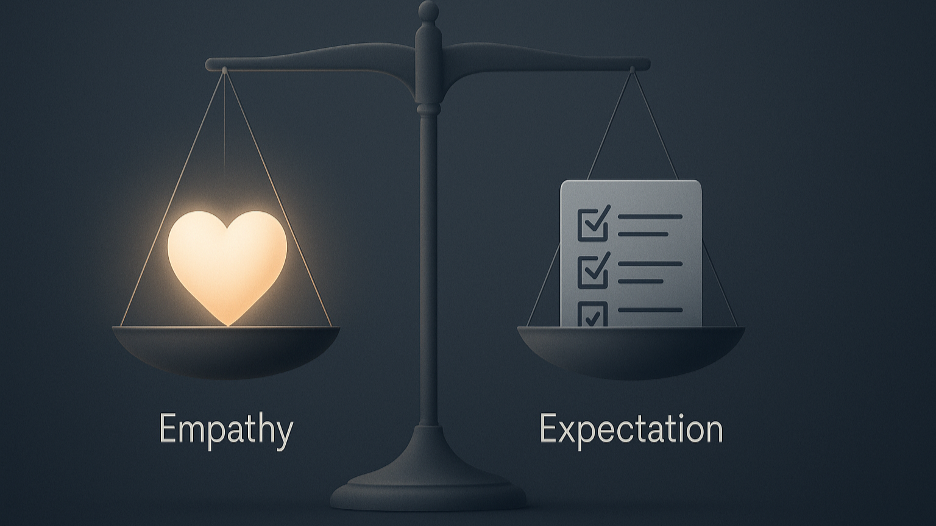
Empathy is essential for leadership. It builds loyalty, safety, and trust. But the same trait that makes people feel seen can also make them dependent.


When you can’t tolerate someone else’s discomfort, you start protecting them from it. You step in to fix, to soothe, to rescue.

It looks noble. It feels generous. But it quietly steals agency — theirs and yours.


Your team stops growing because you’re doing their emotional labor. You stop leading because you’re managing feelings instead of outcomes.


That’s the hidden cost of care.


The Emotional Guilt Loop

Over-empathetic leaders live in a constant tug-of-war between compassion and guilt.


They think:

“They’re already stretched — I can’t pile more on.” “If I push harder, I’ll seem uncaring.” “I’ll just do it myself; it’s easier.”

Sound familiar?


That’s not empathy anymore. That’s guilt masquerading as kindness. And guilt makes terrible business decisions.


Because guilt doesn’t guide you toward what’s right. It just steers you away from what feels uncomfortable.


A Founder’s Story

One founder I coached, let’s call her Lina, led with heart. She built her company around “people first.” And she meant it.


But somewhere along the way, “people first” turned into “me last.” She couldn’t say no. She kept saving underperformers, approving vacations during crunch time, rewriting others’ work to spare them stress.


Her team adored her — until they didn’t.


Because beneath her helpfulness was quiet resentment. And resentment always leaks.


The breakthrough came when she realized something simple but hard:

“I was protecting people from learning the hard parts of growth.”


That’s when she started leading again instead of parenting.


When Caring Becomes Control

Here’s the paradox: the more you care, the more you risk over-controlling.


You jump in to fix not because you don’t trust them, but because you feel for them. It’s empathy turned inward — I can’t stand watching them struggle.


But leadership isn’t about eliminating discomfort. It’s about using it wisely.


People grow by stretching, not by being spared.


When you save someone from every failure, you’re also saving them from competence.


The Biology of Burnout

Chronic empathy triggers chronic stress. When you absorb other people’s emotions all day, your nervous system never gets a break.


You start mirroring everyone’s anxiety like an emotional amplifier. Your brain thinks you’re in crisis — even when you’re not.


That’s why over-caring leaders are often the first to burn out. Their compassion becomes constant cortisol.


The irony? The leaders who want to create safety for others end up unsafe themselves.


How to Care Without Carrying

  1. Feel, then filter. It’s okay to feel someone’s frustration. Just don’t keep it. Ask: “Is this mine to hold?”
  2. Help through accountability. Say, “I know this is tough, and I also need you to take ownership.” The and matters.
  3. Let discomfort be developmental. When a team member struggles, resist rescuing. Stay present, not protective.
  4. Coach before you comfort. Instead of “Don’t worry,” try, “What do you think your next move is?”
  5. Reframe empathy as empowerment. Caring isn’t about absorbing pain; it’s about believing people can handle it.


Funny but True

One exec I worked with told me, “Every time I stop helping, I feel like a jerk.”


I said, “No — you feel like a leader. It just takes a while to tell the difference.”


He laughed and said, “So… you’re telling me leadership feels bad at first?” I said, “Exactly. Growth always does.”


The Cultural Ripple Effect

When leaders overfunction, teams underfunction. When leaders hold space instead of taking space, teams rise.


Empathy should expand others, not consume you.


The healthiest cultures balance care and candor — support and stretch. They normalize struggle as part of the process instead of something to be hidden or rescued.


That’s what real compassion looks like in motion.


The Maturity of Tough Empathy

Empathy without boundaries is exhaustion. Empathy with boundaries is wisdom.


The mature version of empathy doesn’t say, “I’ll protect you.” It says, “I believe you can handle this — and I’ll walk beside you while you do.”


That’s not cold. That’s developmental.


Your Challenge This Week

Notice where you’re rescuing someone instead of coaching them. Pause before you step in. Ask yourself, Am I helping because they need it — or because I need to feel helpful?


Then take one small risk: let them handle it.


They’ll probably surprise you. And you’ll feel lighter than you have in months.


Final Word

Caring is beautiful. It’s what makes you human.


But unchecked empathy turns leaders into emotional pack mules — carrying what was never theirs to bear.


Real leadership is still full of heart. It just remembers that compassion without accountability isn’t love. It’s fear.


And the moment you stop rescuing everyone, you finally start freeing them — and yourself.

share this

Related Articles

Related Articles

The Courage to Confront: How Real Leaders Balance Candor and Care
By Rich Hagberg December 16, 2025
(Part 2 of The Best Leaders Playbook — Building Trust Systems Series)
Integrity as an Innovation Strategy: Why Moral Clarity Drives Creativity, Not Just Compliance
By Rich Hagberg December 9, 2025
(Part 1 of The Best Leaders Playbook — Building Trust Systems Series)
Greatness Lies in the Contradictions: How the Best Leaders Integrate Opposites Instead of Choosing S
By Rich Hagberg December 2, 2025
The Leadership Tightrope If you lead long enough, you start to realize something uncomfortable: everything that makes you effective also threatens to undo you. Your drive becomes impatience. Your confidence becomes stubbornness. Your empathy turns into guilt. The longer you lead, the more you realize that the job isn’t about choosing one trait over another — it’s about learning to carry both. That’s what maturity looks like in leadership. It’s not balance. It’s tension well managed. The False Comfort of Either/Or Most leaders crave clarity. We want rules. Playbooks. Certainty. Should I be tough or kind? Decisive or collaborative? Visionary or practical? The insecure part of the brain hates contradiction. It wants the “right answer.” But leadership lives in the messy middle — the place where both truths exist, and neither feels comfortable. The best leaders aren’t either/or thinkers. They’re both/and navigators. A Story from the Field I once coached a CEO who told me, “I’m torn between holding people accountable and being empathetic.” I said, “Why do you think those are opposites?” He paused, then laughed. “Because it’s easier that way.” Exactly. It’s easier to pick a lane than to learn how to drive in two at once. He eventually realized the real question wasn’t which side to choose, but when and how to lean into each. He became known as “the fairest tough boss in the building.” That’s the magic of integration — toughness with tenderness, vision with realism, clarity with compassion. Why Paradox Feels So Hard Contradictions feel like hypocrisy when you haven’t made peace with your own complexity. If you believe you have to be one consistent version of yourself — confident, decisive, inspiring — then every moment of doubt feels like fraud. But the truth is, great leaders are contradictory because humans are contradictory. You can be grounded and ambitious, humble and proud, certain and still learning. The work is not to eliminate the tension — it’s to get comfortable feeling it. The Psychology Behind It Our brains love binaries because they make the world simple. But complexity — holding opposites — is the mark of advanced thinking. Psychologists call this integrative complexity — the ability to see multiple perspectives and blend them into a coherent approach. It’s not compromise; it’s synthesis. It’s saying, “Both are true, and I can move between them without losing my integrity.” That’s where wisdom lives — in the movement, not the answer. Funny But True A client once told me, “I feel like half monk, half gladiator.” I said, “Congratulations. That means you’re leading.” Because that’s what the job demands: peace and fight, compassion and steel. If you can’t hold both, you end up overusing one until it breaks you. The Cost of One-Dimensional Leadership We’ve all worked for the “results-only” leader — brilliant, efficient, and emotionally tone-deaf. And the “people-first” leader — kind, loyal, and allergic to accountability. Both are exhausting. Both create lopsided cultures. When leaders pick a single identity — visionary, disciplinarian, nurturer, driver — they lose range. They become caricatures of their strengths. True greatness comes from emotional range, not purity. The Paradox Mindset Here’s how integrative leaders think differently: They value principles over preferences. They can be decisive without being defensive. They know empathy isn’t weakness and toughness isn’t cruelty. They trade perfection for adaptability. They’re the ones who can zoom in and out — from the numbers to the people, from the details to the meaning — without losing coherence. They’re not consistent in behavior. They’re consistent in values. That’s the difference. How to Practice Both/And Thinking Spot your overused strength. The strength that’s hurting you most is the one you lean on too much. If you’re decisive, try listening longer. If you’re compassionate, try being direct faster. Ask, “What’s the opposite quality trying to teach me?” Impatience teaches urgency; patience teaches perspective. You need both. Invite your opposite. Bring someone onto your team who balances your extremes — not a mirror, a counterweight. Hold paradox out loud. Tell your team, “This decision has tension in it — and that’s okay.” Modeling that normalizes complexity for everyone else. A Moment of Self-Honesty I’ve spent decades watching leaders chase “clarity” like it’s peace. But peace doesn’t come from eliminating tension. It comes from trusting yourself inside it. Once you accept that leadership will always feel contradictory, you stop fighting it — and start flowing with it. You don’t need to be the calmest, toughest, or most visionary person in the room. You just need to be the one who can stay whole while the world pulls you in opposite directions. Your Challenge This Week When you catch yourself thinking, “Should I be X or Y?” — stop. Ask instead, “How can I be both?” Then practice it in one small moment. Be kind and firm. Bold and humble. Fast and thoughtful. That’s where growth hides — in the discomfort between two truths. Final Word The best leaders aren’t balanced. They’re integrated. They’ve stopped trying to erase their contradictions and started using them as fuel. They’ve learned that leadership isn’t about certainty. It’s about capacity — the capacity to hold complexity without losing your center. That’s not chaos. That’s mastery.
ALL ARTICLES