Article
The Judgment Trap: Why Smart Leaders Keep Making Dumb Decisions

You’ve probably sat in that meeting—the one where everyone nods, the plan sounds brilliant, and something inside you whispers, “This feels off.”
Then six months later, the numbers tank, the team fractures, and nobody remembers who actually decided.
In my long coaching career, I’ve seen it too many times. Great ideas and inspiring vision coming down to smoke and ash. Smart, driven executives—people who built companies, raised rounds, changed industries—still fall into predictable judgment traps.
Not because they’re careless. Because they’re human.
The Hidden Architecture of Bad Decisions
Every bad decision has two layers. On the surface: logic, data, and justification. Underneath: emotion, fear, and ego.
Most leaders debate facts and models, but what really drives the call is the invisible need to feel safe, competent, or in control.
When you miss that layer, you mistake momentum for clarity and conviction for truth. That’s how companies derail while leaders are still congratulating themselves for being decisive.
1️⃣ The Speed Illusion
Speed feels powerful. It gives relief from ambiguity. But urgency isn’t strategy—it’s self-medication for anxiety.
Founders equate slowing down with weakness. They move fast because stillness feels unbearable. Yet every “fast” decision eventually slows the company—rework, reversals, lost trust.
Real speed comes from reflection. Pausing to ask, “What problem am I actually solving?” is the fastest move you’ll ever make.
2️⃣ The Confidence Mirage
After enough wins, confidence starts masquerading as accuracy. The brain confuses familiarity with truth.
It’s seductive. You’ve seen this pattern before; you know how it plays out. Except this market is different. This team is different. You are different.
Overconfidence blinds leaders to nuance and punishes curiosity. The antidote is humility baked into process: someone on your team must be paid to prove you wrong. If no one can, your culture’s too polite—or too scared.
3️⃣ The Echo Chamber
Nothing kills judgment faster than agreement. When everyone smiles and nods, it feels like alignment. It’s actually avoidance.
Teams stop challenging you not because you’re right, but because it’s unsafe to be honest. That’s sunflower bias: people orienting to the boss’s preference like plants to the sun.
If you want better decisions, be the last to speak. Reward the person who changes your mind.
4️⃣ The Emotional Hijack
Anger, pride, and fear are terrible decision tools—but exquisite disguises. They look like conviction. They sound like leadership.
When emotion drives the bus, judgment rides in the trunk. I’ve seen executives make firing decisions in rage and acquisitions in euphoria. Both felt certain. Both collapsed later.
Emotional regulation isn’t soft skill—it’s cognitive hygiene. If you can’t calm your nervous system, you can’t access your wisdom.
5️⃣ The Binary Trap
Under pressure, complexity collapses into yes/no. Hire or fire. Launch or kill. Acquire or walk away.
It feels efficient—but amputates imagination. The danger isn’t choosing wrong; it’s never seeing what else was possible.
My rule: three options minimum. If you can’t name three, you’re not deciding—you’re reacting.
6️⃣ The Hero Complex
Many founders believe leadership means having the answer. It doesn’t. It means designing the system that gets to the answer.
Heroic decision-making doesn’t scale. It breeds dependency and fear. When every big call runs through you, the company stops learning.
Leadership maturity is letting go of being right so the organization can be smart.
7️⃣ The Reversal Loop
Some leaders can’t stop re-deciding. They add “one more thing,” change direction midstream, or quietly undo yesterday’s call.
It feels adaptable. It’s actually destabilizing.
People stop believing you because they’re waiting for the next reversal. Write down the decision, the rationale, and the success indicator. Revisit it only if assumptions change—not if your anxiety does.
8️⃣ The Overload Fallacy
The modern executive disease is information addiction. We convince ourselves that more data equals better judgment. It doesn’t. It equals paralysis.
“Let’s gather more data” is often code for “I’m afraid to decide.” Define the minimum information needed for a quality call. Then decide. You’ll make faster mistakes—and faster progress.
9️⃣ The Politics of Preference
Many bad decisions aren’t analytical—they’re social. Leaders favor the messenger over the message. Bias hides in plain sight—in who gets airtime, forgiveness, and credit.
If your decisions correlate with who you like most, judgment has already left the room.
🔟 The Culture of Silence
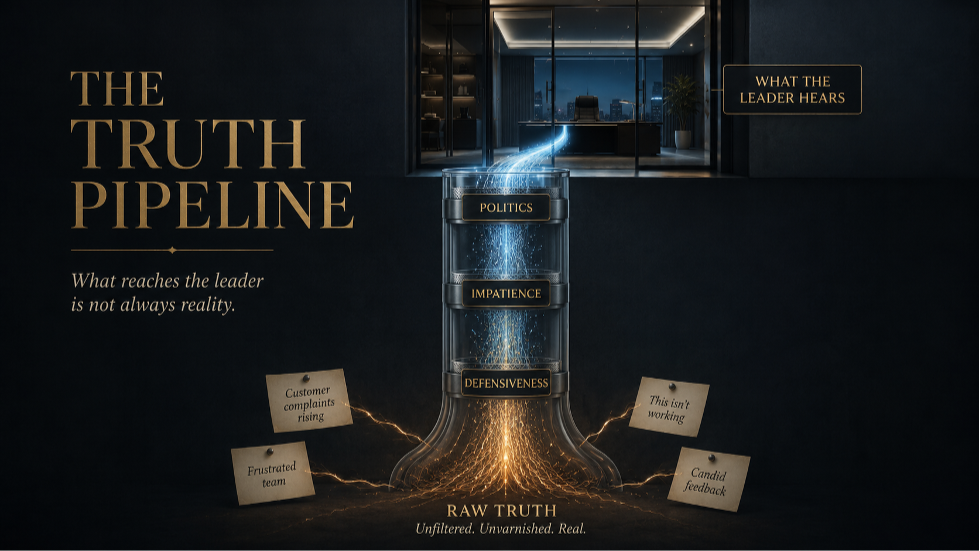
The most dangerous phrase in business isn’t “We failed.” It’s “No one told me.”
When truth becomes expensive, companies go bankrupt buying harmony. People stop telling the truth long before the numbers reveal it.
Psychological safety isn’t comfort—it’s accuracy. The day your team stops disagreeing with you is the day your decline begins.
The Fear Beneath It All
Beneath every bad decision is fear. Fear of being wrong. Fear of losing control. Fear of being seen as weak.
And fear always demands speed, certainty, and dominance—the three enemies of judgment.
The Discipline That Saves You
Better judgment isn’t a personality trait; it’s a design choice. Build systems that slow thinking without killing action.
🟦 A pre-mortem before launch.
🟦 Three options before closure.
🟦 One dissenting voice before consensus.
🟦 A decision journal reviewed quarterly.
These small rituals do what ego can’t—they make you wiser before experience humbles you.
The Mirror Moment
Every leader eventually faces it—the moment you realize the enemy isn’t chaos. It’s your own certainty.
Maturity is learning to pause in that quiet space between knowing and not knowing. That’s where judgment lives.
Before your next big call, ask yourself: What if the part of me that’s most confident is also the part most afraid?
Because in my experience, that’s where the truth usually hides.
share this
Related Articles
Related Articles